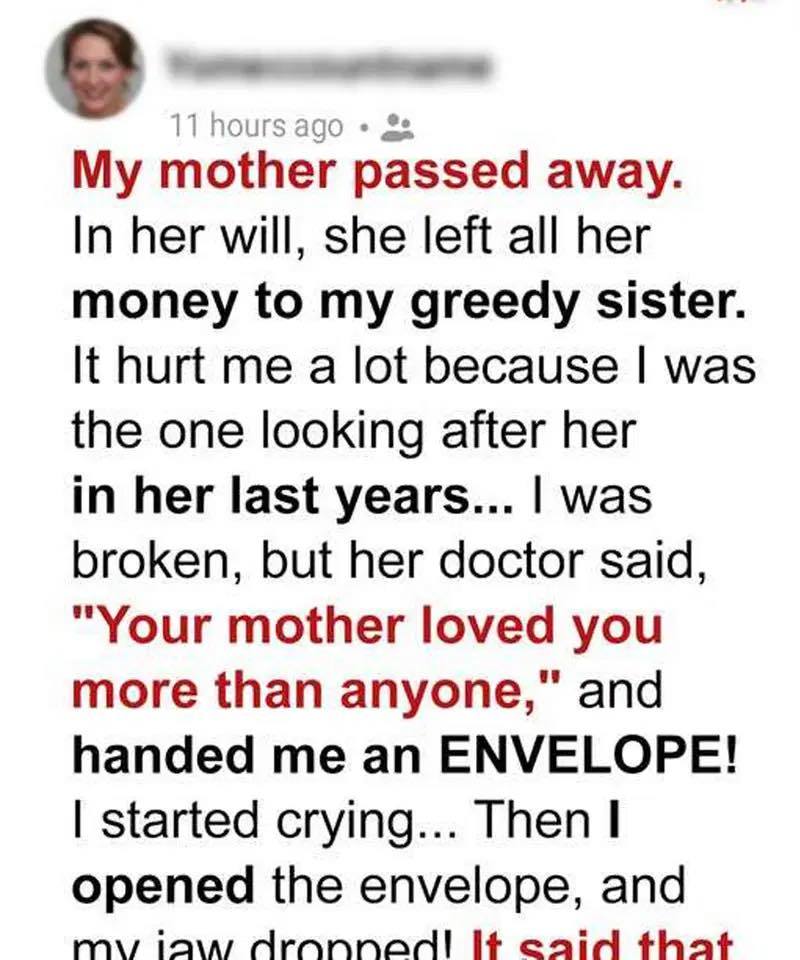
The rain fell in sheets the day they buried my mother.
I stood at the edge of the grave, my hands numb, my chest hollowed out, as if grief had reached in and taken everything vital. For three years, I’d been her hands, her voice, her memory. I’d held her through seizures, whispered stories to soothe her dementia, kissed her forehead a thousand times when the world had already begun to slip away.
And yet—when the lawyer’s voice cut through the silence of his oak-paneled office days later—there it was, written in sterile legal ink:
“All real and personal property… to my daughter, Sybella.”
No explanation. No apology. Just silence—worse than any words.
Sybella didn’t cry at the funeral. She dabbed her eyes with a tissue and left early, heels clicking like a countdown, already scrolling through designer handbags on her phone.
But before I walked out, shoulders slumped, the kind doctor who’d held my mother’s hand in her final breath stopped me in the hallway.
He pressed a small, cream-colored envelope into my palm. His eyes—tired, kind—held mine.
“She loved you more than anyone,” he said softly.
“This… this was for you.”
My breath caught. The paper was warm, almost pulsing. On the front, in my mother’s looping script:
For Lila. Open when the world feels too heavy.
I drove home in a daze. When I finally opened it, kneeling on my kitchen floor, the first sentence stole the air from my lungs:
“This cabin is where I felt the happiest when I was young.”
Not a cabin. The cabin.
I’d never heard her speak of it. Not once. Not in thirty-six years of bedtime stories, Sunday drives, or late-night teas. But here it was—a hidden refuge, tucked deep in the Blue Ridge Mountains, deeded solely to me. A key taped to the letter. A faded map drawn in pencil.
And then, the quiet bomb:
“I hope you’ll go there and find peace… and answers.”
The Road to Nowhere—and Everything
Six hours north, the city bled away. Pavement gave way to gravel. Cell service vanished. Trees arched overhead like cathedral vaults, and the air—cool, pine-scented, alive—filled my lungs for the first time in years.
Then I saw it.
Nestled in a valley where the mist clung like lace, the cabin stood—low and sturdy, built of river stone and cedar. Ivy curled around the chimney like it was hugging the house. The porch sagged slightly, worn smooth by decades of footsteps. It didn’t look abandoned. It looked waiting.
Inside, time had paused.
Sunlight streamed through dust-moted air, illuminating a stone fireplace, a wool rug frayed at the edges, and a mantle crowded not with trinkets—but with photographs.
There she was: my mother, impossibly young, barefoot in a faded sundress, her hair wild in the wind, laughing as a tall, dark-haired man lifted her off her feet. Behind them, this very cabin.
And there, in his arms—a baby. A boy.
Not me.
My knees buckled.
On a shelf beside the hearth, a leather journal lay open—as if she’d just stepped away. I sank into the armchair, fingers trembling, and read:
June 12, 1987
Cedric says we should stay. Build a life here—grow vegetables, raise chickens, let the boy run barefoot in the grass. But the city calls. His job. My father’s illness. We’ll come back, I promise. Just for a little while.April 3, 1989
I can’t keep him safe there. Not with the threats. Not with the court looming. So I let go. I sign the papers. I kiss his cheek one last time and whisper: “Be brave, Jasper. Mommy loves you. Always.”October 17, 2010
Lila asks about the mountains today. I almost told her. But how do you explain a ghost you carry in your heart?
JASPER.
The name echoed in my skull like a struck bell.
The Search
I tore the cabin apart—gently, reverently. Under floorboards warped by time, in a tea tin behind flour sacks, in a hollowed-out copy of Wuthering Heights, I found pieces of a life erased:
- Faded letters from a man named Cedric, his words full of love and desperation:
“He asks about you every night. He has your eyes.” - A birth certificate:
Jasper Bellamy.
Mother: Eleanor Voss.
Father: Cedric Bellamy. - A single photograph, tucked in a Bible: a toddler in overalls, grinning, missing two front teeth—my brother—holding a frog like it was treasure.
By dawn, I was at the public library, heart hammering, asking about a man named Jasper.
Mrs. Tawny, the librarian—eighty if she was a day, eyes sharp as flint—leaned in.
“Oh, him,” she said, voice softening. “Used to come in every Saturday. Always checking the newspaper archives. Said he was looking for the mother who gave him a second chance… and the sister he never knew.”
She tapped the counter.
“He fixes cars now. Bellamy Auto. Two blocks down.”
The Meeting
The shop smelled of oil and warm metal.
He stood by a lifted Mustang, sleeves rolled, forearms streaked with grease. Dark hair, same as the photo. But it was his eyes—the exact shade of storm-gray blue—that made me stop breathing.
I walked forward, legs unsteady.
“Excuse me,” I said, voice barely a whisper. “Are you… Jasper?”
He turned.
Time folded.
He stared. Blinking once. Twice. Then, slowly, his hand went to his chest—as if to steady a sudden jolt.
“Yes?” he said, wary.
I held out the journal.
He opened it. Read the entry about the boy by the creek. His breath hitched. He looked up at me—really looked—and something in his face unlocked.
“My mother,” he said, voice thick, “told me I had a sister. She said… she said the world wasn’t kind to women who loved too fiercely. So she let go of me to hold on to you.”
We didn’t hug. Not yet. But we sat on the curb, two strangers bound by blood and silence, and wept—for the years lost, for the mother who carried two kinds of love in one fragile heart.